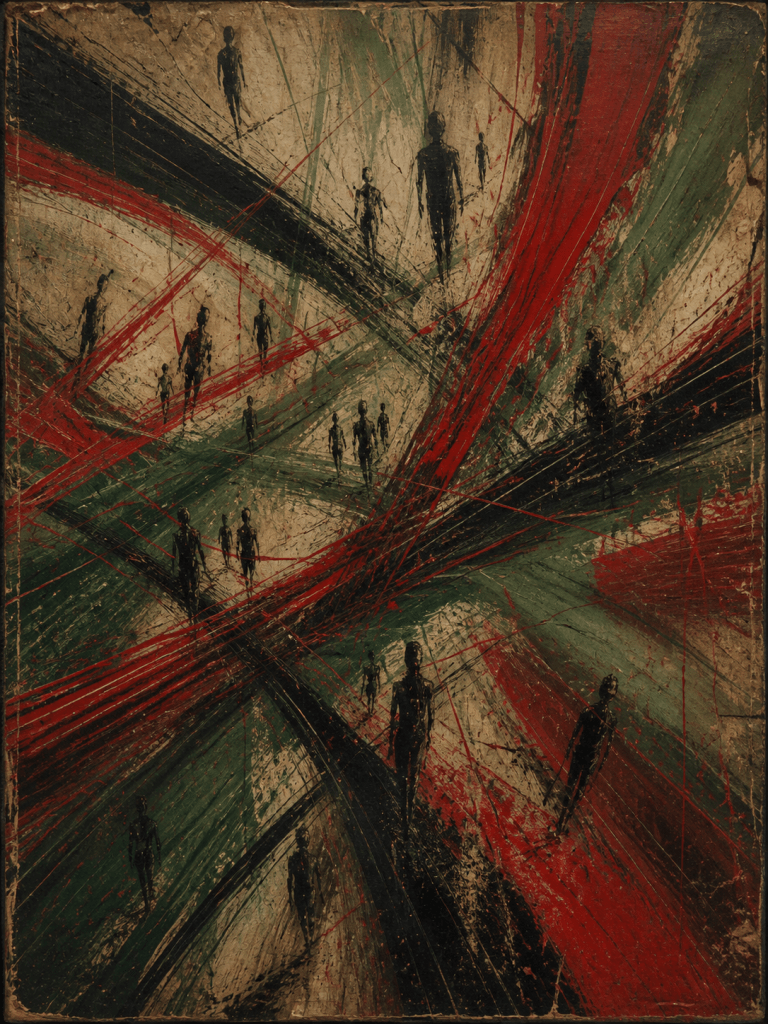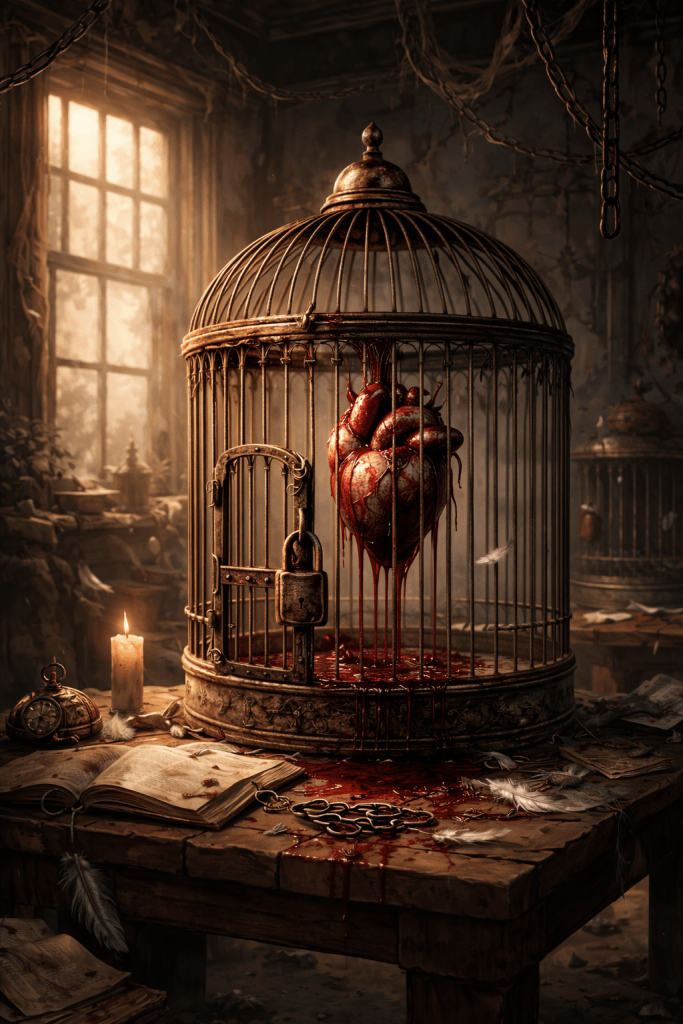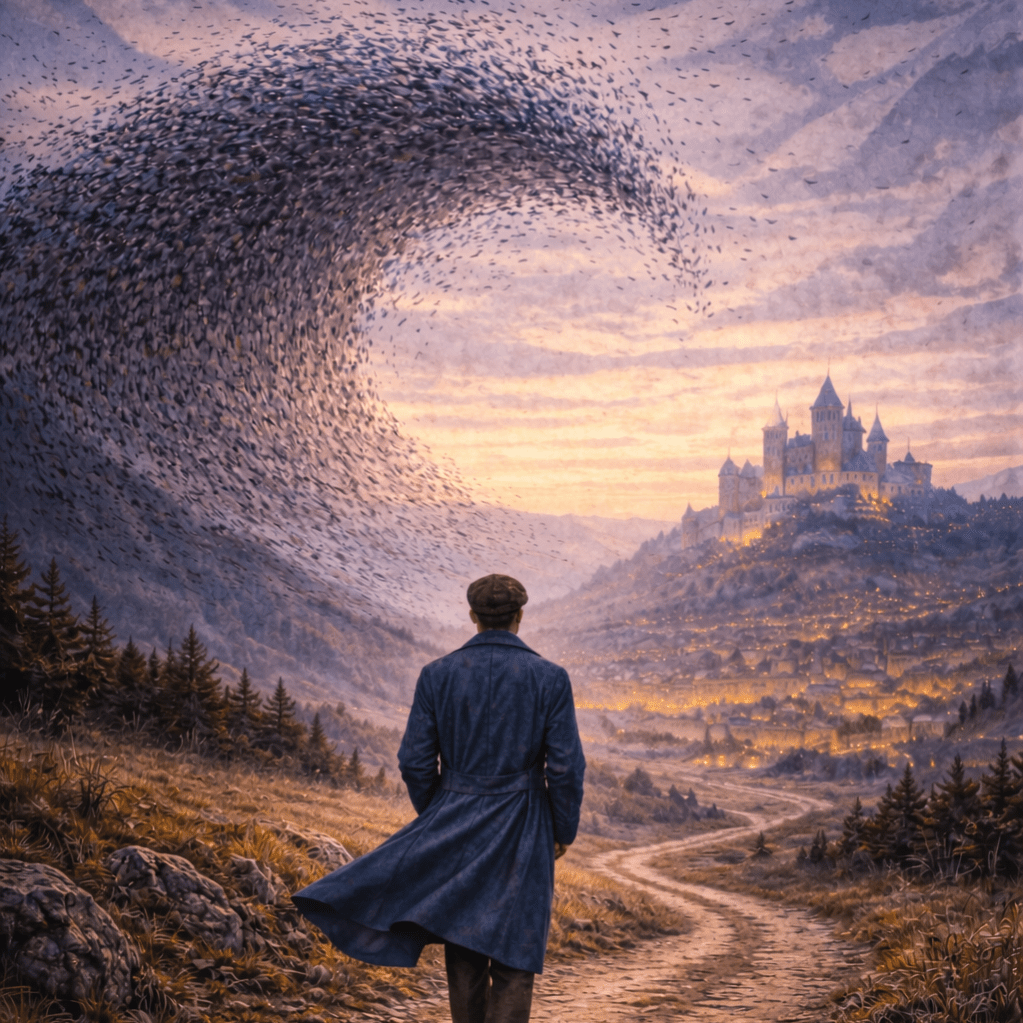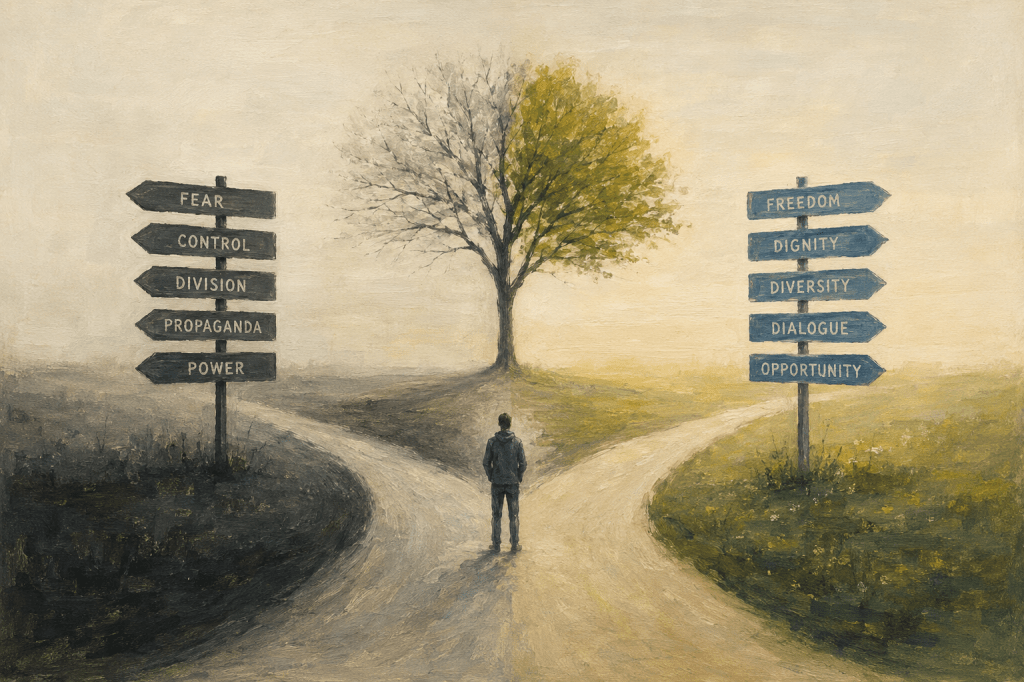
I called this work, “the carriage.” It is about a lifelong confrontation with an unseen control system. The forces that claim authorship over our lives. It’s about living just outside the architect’s clean lines, believing you were meant for something you created, only to realize something else has been keeping score the whole time.
The narrator isn’t a savior or a friend. He’s the arbiter; the accountant of time and intention. While you were dreaming, creating, laughing, trusting yourself, he was building the world around you. Every gift was a loan. Every moment came with interest.
The song asks a quiet and dangerous question: when you close your eyes and imagine freedom, what are you really doing with it? Are you building something that lasts, or just running until the walls appear?
This is a story about control disguised as order, fate disguised as fairness, and the moment you realize the blueprint was never yours.
I have posted my original version recorded about 2 years ago and the Suno version. I like them both, but the Suno version added some anger I don’t think I could express. If you have time, listen to both and let me know what you think!
LYRICS:
[Verse 1] You got big dreams, boy See, I got other plans You can keep on runnin’, but one day you will dance To the beat that I stir The beat I create I’ve givin’ you time Now it’s my time to take
[Chorus] It just keep on runnin’, boy, as fast as you can You got ideas and I got real big plans This great big world you let just slip right past And I’ll just keep takin’ ’til you understand That your tears are like wine That console my ache Of disappointing choices that you continue to make I’m gonna catch you, gonna drop you to your knees I’m the architect, you do as I please
[Verse 2] the arbiter between what’s real and what’s fake What you get right and what you mistake What you can see and what you believe What’s really there and what is a dream [lead guitar]
[Chorus] I ain’t no friend I ain’t no saint While you believed in miracles, I built this place I’ve given you gifts, I’ve given you time You used it for fun, now those gifts are mine
I ain’t no friend I ain’t no saint You believe in miracles, I’ll build this place I’ve given you gifts, I’ve given you time You used it for fun, now those gifts are mine
I ain’t no friend I ain’t no saint You’ll believe in miracles, while I built this place I’ve given you gifts, I’ve given you time You used it for fun, now those gifts are mine
Wrote this tiny little essay in my Sophomore year Philosophy Course. Enjoy, or hate it.
We like to say we love people. Bodies. Names. Faces. But if we’re honest—brutally honest—those are just the containers. What we love is never the carbon itself. We love what happens inside and beside it. The way time behaves when someone is near. The feeling of being known and knowing (trust). The brief and absolute suspension of loneliness when that other consciousness overlaps our own.
Nobody aches for bone and tissue. We ache for moments.
When someone leaves our life, we don’t miss their skin or their weight or even the details of their fingerprints. We miss the feeling of their skin, their weight. The sound of their laugh in a moment—or a thousand moments all at once. That’s what hurts most: not the loss of a person, but the loss of access to a version of ourselves we only became in their presence.
Humans treat love as property—as if someone can be owned emotionally the same way a old chair or a house can be owned physically. But intimacy isn’t a possession. It’s an event. And events end. The tragedy isn’t that people die or leave. The tragedy is that moments never remain still long enough for us to notice we’re inside them until they’re already past.
When we meet someone, they always ask where you’re from or where you’re going. No one ever asks, “Who are you right now?”
Memory is the real wound. Not abandonment. Not distance. Memory is proof that something happened once that no longer exists. Every ache is simply time reminding us that it only moves forward—and in the spirit of Anna Nalick, “the hourglass is still glued to the table.”
We often say heartbreak is about someone else—but it isn’t. It’s about ourselves. It’s grief over losing who we were while someone was around. That version of us becomes unreachable without them. Not dead—just sealed off in time, like an old room we no longer enter.
People confuse longing for a return of themselves with wanting another person. What they really want is the weather of those years. The emotional climate. The familiar gravity. The internal rhythm that existed then, but is unreachable now. No one wants their ex back. They want their nervous system back. They want what once felt like simple mathematics.
We believe love must be eternal because we cannot tolerate how temporary it actually is. But fleetingness is not a flaw. It’s the entire meaning. If moments were permanent, there would be nothing sacred about them. The reason a touch matters is because it ends. The reason a voice cuts through us is because one day it will never reach us again.
Everything worthwhile decays. That doesn’t invalidate it. It proves it was real.
We don’t mourn people. We mourn time that will never happen again in the same way.
And calling that “love” is the most honest and comforting lie humanity ever invented— because the truth would be too clean, too cold, and too piercing to survive.
Ever met someone that you believe would be a perfect companion, only to realize they believe something that you don’t, perhaps they believe in a ghost or and idea that your little section of the world say is bad or worse–doesn’t exist. Why do we do this to each other? Is it for money? Is it for longing and the scarcity we feel in every day life? This song was written 25 years ago.
Verse
Did you ever realize
We’ve been sold a pack of lies
Your world’s red and mine is blue
both of us living the same sad truth
Protests in the streets
Signs raised to the sky
Who is it getting wealthy, from the ache in our lives
Chorus
Divided we stand, united we fall
It ain’t about us It’s about us all
Divided we stand, united we fall
What if they caught us tearing down the walls
That separate us, that infuriate us
That remind us that we are not the same, but we are
Verse 2
You got a version of the truth, that I’ve never known
Wanna really see em’ mad then let’s compare notes
Then I might learn where your lines come from
And you can see mine too, after that we’ll have to run
Cuz we may see who’s counting dollars, While we’re counting scars
Who’s really lighting the fires, and leaving us in the dark
Chorus
Divided we stand, united we fall
It ain’t about us It’s about us all
Divided we stand, united we fall
What if they caught us tearing down walls
That separate us, that infuriate us
That remind us that we are not the same, but we are
Bridge
Divide and conquer, that’s what they believe
They told us in the history books, we didn’t read
Divide and conquer, didn’t think they meant me
Let you love, let you hate but you’ll never be free
Let you lust let you fight but you never be free
Let you trust let you hurt but you’ll never be free
You’re here to work, you’re here to slave but you can never see
This is a more recent work. I wrote the lyrics while I was in Africa last year (2024), after watching a drive-through documentary on the human decay across the Appalachian Mountains. I was born in West Virginia. If not for the grace of God, I would likely be a coal miner or an engine driver.
The documentary broke my heart — it captured real desperation. I wanted this song to reflect that film through the lens of my own experience. I stripped it of sentimentality and aimed for gravity and painful realism — not a “pretty tragedy” and absolutely no postcard sadness. When it ended, I set my iPad down with a weight in my stomach. My goal was for this song to leave the same mark.
This is a link to the documentary if you interested in watching:
LYRICS
Verse 1
Ya know, the mountains can’t promise tomorrow
They just teach your back how to bend
Born between the Bible and a bottle
one’s the real thing, the other’s pretend
There’s a holler where hope go’s missing
Like a joke that chills the room
Where the boys learn not to ask questions
And girls grow too old, too soon
we don’t talk about dreams where I’m from
They all land like a small-town joke
We just talk about the mileage and the money
how many times we’ve elected real hope
There’s a dirt road with bones in the gravel
And a church with a flickering cross
Half the town’s lost track of their children
the other halves learned not to watch
Chorus
Ohhhh, don’t nobody here want oblivion
just looking for an honest day’s pay
ya know God don’t answer his phone here
he just looks the other way when we pray
we’d chase anything to find meaning
Even if it’s all colored up in gray
Some pain is a bruise to the ego
Some pain is the edge of a blade
Some pain teaches you survival
Some teaches you how to behave
(Some pain never fades, some pain never fades)
Verse
There’s a boy with his mother’s sad eyes
Selling pills by an old school-bus sign
Tells himself it’s only just for a season
But the seasons never end here on time
There’s a girl who still dreams in her sleep
Wakes up in a sweat every night
Says, “I swear I was born for a reason”
Then clocks-in every day to survive
verse 3
The factories all folded like scripture
that no one remembered to read
the future is sold by the ounce here
and no one ever looks twice when you bleed
We were taught to be proud of our sufferings
Wear em’ like our best Sunday clothes
But pride will keep you alive, past living
Till there’s nothing left that’s your own
Chorus
Ohhhh, don’t nobody here want oblivion
just looking for an honest day’s pay
ya know God don’t answer his phone here
he just looks the other way when we pray
we’d chase anything to find meaning
Even if it’s all colored up in gray
Some pain is a bruise to the ego
Some pain is the edge of a blade
Some pain teaches you survival
Some teaches you how to behave
(Some pain never fades, some pain never fades)
Bridge
The mountains don’t owe you a god dammed thing
For years they’ve watched us come and go
From the nights where the silence is screaming
To the days where they hum soft and low
Where the mountains hum so soft and low
Chorus
Ohhhh, don’t nobody here want oblivion
just looking for an honest day’s pay
ya know God don’t answer his phone here
he just looks the other way when we pray
we’d chase anything to find meaning
Even if it’s all colored up in gray
Some pain is a bruise to the ego
Some pain is the edge of a blade
Some pain teaches you survival
Some teaches you how to behave
(Some pain never fades, some pain never fades)
Press Blurb:
This song confronts Appalachia without myth or sentimentality. Built on industrial Americana textures — grinding guitars, mournful violins, and drums that feel like failing infrastructure — it rejects nostalgia in favor of truth. There is no romantic ruin here, no polished sorrow. The lines observe instead of perform, documenting a region shaped by endurance, addiction, and inherited silence.
Written from personal connection rather than distance, the song moves through collapsing towns with quiet accuracy. It names what is often edited out: pride as survival, numbness as defense, and pain as instruction. The chorus refuses metaphor and categorizes its subject plainly: “Some pain is the edge of a blade / Some pain teaches you survival / Some teaches you how to behave.”
Rather than offering solutions, the song leaves a weight. Not resolution — recognition. It does not console the listener. It tells them the truth and trusts them to sit with it.
Actually it could do it, but everything it rendered was absent the feeling I had when I first wrote and recorded it. So apologies up front, this is not AI. This is 3 weeks of work in my personal studio. It’s much less polished than the AI renders.
Verse
The phone woke me up about 11 am
after a night out of drinking with friends
fresh from a dream I answered anyway
was my old friend from the war
he said he wasn’t ok
That he felt perfectly alone in a crowded room
and when his wife would hold him, he felt alone too
and he didn’t know who to call,
he’d never made many friends at all
Verse
Was it the things that we did or things we had to do?
to make it back home or just pull through?
he said no man, I’d do em’ all again
I just can’t relate to anyone around I call friend
Who’s never felt the rush of a C-RAM at dusk
or the fear that has you sleeping with your vest in your bunk
or that first shot you take you know lands true
or missing a life that ain’t waiting on you
[piano interlude]
Verse
So We talked all night about this and that
about things I couldn’t write in a song
about muddy boots in the pouring rain
and all the beautiful ladies that got away
Verse
So that text the next morning had me somewhat confused
it was my same old friend, who couldn’t shake the blues
“by the time your read this note”
“I’ll be gone you’re the first to know”
Chorus
I’m on the other side, I’m on the other side
I know you won’t thing it’s right,
but I ain’t the same man that kissed her goodbye
I’m on the other side, I’m on the other side
oh please don’t hate me friend,
but this life ain’t a game I care to win
[blues guitar lead]
Verse
I miss the friends that fear and pain made
Where we never once thought about the price we’d pay
to leave the volume up on ten
then run back home and try to pretend
that those moments just fade, when those moments pass
or that it’s easy to escape a shattered past
one more statistic for your trope,
you can’t purchase good men you can’t elect real hope
Ya know relationships are hard. What’s even harder is taking all the things you feel relative to a relationship and expressing them in one salient little tune. I penned this little tune sometime around the early-2004 timeframe just after a nasty little breakup. I pressed record, picked up a guitar and sang it through once. Found it the other day looking through my files and archives. Man I was angry at that point in my life. Suno did it justice, sounds exactly like I would have recorded it.
Verse 1
My friends say life shouldn’t be that hard
I told em’ to spend some time with you
Baby, tell me one last time how worthless I am
‘Cause I don’t think it’s getting through
I am done with this life
Was trapped inside your hell now I’m on the other side
No more always being wrong
No more hateful woman to ignore my songs
Chorus
And there will come a day you’ll find yourself alone
That day will come sure as the cold wind blows
And there will come a day when you will lose it all
And I finally get to watch you fall
Verse 2
It’s not that I hate you, or mean you any pain
See I got these nightmares that will not go away
You took a hammer to my CDs, threw my glasses on the floor
ain’t nothing left in here, worth fighting for
We had these big dreams back in nineteen ninety three
We’d build a life together, raise a family
I guess things change in life, and people lose their way
Hard to move on, so bogged down in yesterday
Chorus
And there will come a day you’ll find yourself alone
That day will come sure as the cold wind blows
And there will come a day when you will lose it all
And I finally get to watch you fall
[lead]
Bridge
There are those who’s death will cause you pain
Others leave you wishing for just another day
Some leave you glad they finally found escape
But you, I can’t wait. I just can’t fucking wait, because…
Chorus
there will come a day you’ll find yourself alone
That day will come sure as the cold wind blows
And there will come a day when you will lose it all
And I finally get to watch you fall
Chorus
And there will come a day you’ll find yourself alone
That day will come sure as the cold wind blows
And there will come a day when you will lose it all
We all usually end up relating to each other through need. It’s pretty rare to meet someone who feels whole and comfortable in their own space—someone who connects just out of curiosity or genuine interest. That idea feels even more true today, in a world that often runs on scarcity and longing.
I was thinking about this the other day and remembered the book by Shel Silverstein that really stuck with me: The Missing Piece. I wrote this song about 22 years ago, and honestly, it reflected most of the relationships I was in back then—ones built on the foundations of need. That book might be one of the most quietly powerful works I’ve ever read and it deeply influenced this song.
There are so many ways to take The Missing Piece in. You can see it as the frustration of never finding the “right” missing piece and settling for less… or you can see it as learning to smooth your own edges and discovering how to roll on your own. Either way, if you haven’t read it be ready to be affected.
Verse 1
I stitched my soul into your frame,
Borrowed your laughter, gave you my name,
Just a stranger in your crowded room,
Chasing shadows, hiding all the gloom.
Wanted to live in your skin a borrowed me,
world fell apart before I could see
that to view your light, had to dim my own,
Two strangers dancing, song unknown.
Chorus
It’s not my fault that the pieces stay apart,
We were searching blind, two lonely hearts.
You can’t force a fit when it will not go
Needed to know that this was real, not just a show
Sorry, I’m not the echo you thought I’d be,
That I found my voice, and set myself free.
From a missing piece to a soul that grows,
Full human now, not someone you’d want to know
Verse 2
I mirrored your steps, a hollow path,
Lost in your world, lost myself too fast
A drifter clinging to your warm embrace,
But love needs roots, not just time and space.
We offered hunger, with nothing to share
Two souls adrift, gasping for air,
Relating from need, not from the core,
Two halves pretending, but needing more.
Bridge
No blame to hold, no guilt to bear,
We were both lost, needing repair.
You gotta find your heart, your own true song,
Before you bend into where you don’t belong.
A missing piece learns to stand alone,
Builds its life, carves its own.
Chorus
It’s not my fault that the pieces stay apart,
We were searching blind, two empty hearts.
You can’t force a fit when it will not go
Needed to know that this was real, not just a show
Sorry, I’m not the echo you thought I’d be,
That I found my voice, and set myself free.
From a missing piece to a soul that grows,
Full human now, not someone you’d want to know
Chorus
It’s not my fault that the pieces stay apart,
We were searching blind, two empty hearts.
You can’t force a fit when it will not go
Needed to know that this was real, not just a show
This was a short story written back in 1998 for an English course I was taking during work on my bachelors degree. I always loved the story. I got an A+ on it.
I also turned the story into a song:
Title: Ella (love was a long road once)
Artist: One of Jason August’s Many AI Personas
Scene 1
The wipers dragged rain across the windshield in slow, tired sweeps. The coffee had gone cold half an hour back somewhere near Baltimore, and he finished it anyway. Road signs floated out of the wet dark like ghosts—PENNSYLVANIA STATE LINE 56 MILES. He reached down to the dusty floorboard for the map he didn’t really need. The night was cold and strangely bright with mist, and the heater in the old Plymouth was the only thing keeping his hands warm and steady.
By the time he hit York, he had folded and unfolded the same scrap of paper so many times it had the softness of cloth. One hand held the wheel as the other clenched the paper. He watched the drifting lights of passing cars—going somewhere, belonging somewhere. The northbound lanes were empty, all except for him.
A little Spanish radio station crackled through the static. The music was thin, tinny, full of longing. He let it play. He read the numbers again.
Ella—224-1623.
He mouthed the name like a prayer.
“You’ll burn a hole through the floor doing all that pacing, Ella,” her mother said.
Scene 2
“Oh, Mother, I don’t know what to do. He’ll be here in two hours,” Ella said, chewing at a nail, shoulders tight.
“Come sit. Have some of my soup. It’ll settle you.” Her mother’s kidney bean soup had won Best in County last year. It wasn’t the beans—it was the way she seasoned them before they ever met the broth.
Clippings and newspapers were spread across the kitchen floor like leaves. Her mother never threw away a coupon she thought she could use. One headline caught Ella’s eye:
SCRANTON TRAIN SCHEDULE DELAYED BY FREEZING WEATHER.
Her stomach tightened. The spoon felt heavy in her hand. She could feel her heartbeat inside her own mouth.
“Ella, you’ve hardly touched—”
The phone rang.
“I’ll get it,” Ella called, though her mother was already halfway across the room.
“Sit,” her mother said, firm.
She lifted the receiver. “Hello?”
A voice—quiet, shaking—“Is Ella there?”
“No, she went out with friends,” her mother lied, eyes fixed on her daughter. “Who’s calling?”
“Just… tell her James called, please.”
“I’ll tell her,” she said, hanging up before he could say anything else.
Scene 3
The Plymouth’s engine caught, sputtered, settled. He leaned his forehead against the steering wheel. His hair dripped rain onto his jacket. Every muscle in him pulled tight like wire.
Seven months. Seven months of talking to her memory like it was still alive somewhere. He had met her in an all-night diner, the kind where truckers sit with their heads down. It was her eyes that did him in. Eyes that never saw themselves as beautiful.
She would never hurt anyone, he thought.
He drove.
Thirty minutes later, tears came the way rain comes—first nothing, then everything.
“How could she just go out with friends,” he said, trying to steady his voice into something like manhood.
Scene 4
“He doesn’t call for seven months and he thinks he can walk back into your life?” her mother said, cigarette smoke drifting from her hand like punctuation. “He’s no good, Ella. You don’t need him.”
“But Mother—”
“No ‘but.’ You want trouble, that’s how you get it.”
Her mother went to the porch for her nightly drink, and Ella was alone with the rain tapping at the window. She touched the strands of her long blond hair. The clock on the wall ticked softly.
He would be in town now.
She curled her hand over her stomach. Two months more and everything would be different.
Scene 5
He dug through his pockets for dimes, quarters—anything. A few coins hit the pavement. He let them fall. The payphone booth was cold against his back as he dialed.
The city lights of Scranton glowed through fog like a promise that had forgotten itself.
The line rang.
“Hello?” Ella whispered. She knew who it was.
“Oh God, Ella,” James said, voice torn open. “There’s so much I need to tell you. I’m at the little diner. Please—come see me.”
She closed her eyes.
“I’m sorry, James,” she said softly. “I’m going out with friends. I have to go now. Goodbye.”
The phone slipped from her hand and rested against her stomach.
James sat in the mud off the highway, looking at the glow of the city and the dark shape of the mountains rising behind it. His jacket lay beside him. When he’d thrown it, his bag had opened and papers had slid free.
James S. Matthew is hereby released from the Florida State Penitentiary on this day April 12, 1967.
He stared at the words until they stopped meaning anything.
The night was quiet. Rain softened to nothing. Crickets started their song.
There was a single loud crack.
The crickets paused.
Then continued.
The revolver lay in the mud beside him.
And the sky did nothing at all.
Scene 6
Six weeks before the due date, the morning light came in thin and gray through the kitchen window. The rain had stopped sometime before dawn, but everything still seemed wet and quiet. Ella sat at the table, a soup pot still on the stove from the night before, though neither she nor her mother had eaten.
She watched her mother smoking through the window, but her attention drifted to the front door where the mail slot had clattered an hour earlier.
Ella finally rose, slow and heavy, one hand instinctively resting on her stomach. The baby moved—a flutter, a shift—like someone turning over in sleep.
A thin stack of mail lay on the mat. A bill, a coupon circular, and a newspaper.
She sat back down and unfolded the paper. Near the bottom of page six, half-hidden by advertisements for lawn seed and auto parts, there was a short article:
WAYWARD SON FOUND DEAD NEAR SCRANTON HIGHWAY
James S. Matthew, 27, of Jacksonville, Florida, was discovered early Thursday morning near a roadside turnout…
Her eyes moved down the page.
Matthew had recently been released after serving six months for the death of his stepfather, Robert C. Lanning, during a domestic altercation in which Matthew intervened while Lanning was reportedly striking Matthew’s mother. The judge noted the act appeared driven by defense rather than malice. He died of a single self-inflicted gunshot wound.
No photographs. Just facts. The world’s version of a life.
Ella offered the paper to her mother.
Neither spoke.
Only the refrigerator hummed.
Finally, Ella said, “He didn’t leave us. He was coming home.”
Her mother closed her eyes. She had never known how to love—only how to fear, and how to want. It sat heavy in the room between them.
Ella folded the paper carefully, pressing the crease flat with her palm. Not clutching it. Just making it neat. Making it real.
She set it beside her bowl of untouched soup.
Outside, the clouds thinned enough for a small line of sunlight to touch the kitchen floor.
Ella rested both hands on her stomach, holding it the way one holds something precious, something breakable, something that must be carried differently.
The house was quiet.
And in that quiet, she whispered:
“I’ll tell her about you.”
The baby moved in answer.
Abstract/Thoughts:
In the 1960s, distance took on a different weight. There were no screens to collapse miles, no instant clarifications at the tap of a finger. If someone left town, you waited for a letter, and that letter might take days, and in those days the mind did its own traveling. A person’s word had to stretch across highways, across county lines, across seasons. Trust lived in the spaces between postcards, in the long quiet before the telephone finally rang.
People carried each other in memory—whole and intact, or changed in ways they couldn’t yet prove. The world was smaller in what you could know, and larger in what you were left to imagine. And in that space of unknowing, love could grow or fray—quietly, invisibly—until the day someone returned, or didn’t.
Performed by: one of my many AI personas. Every body loves them some AI but every body hate to compete with it.
And yep, that’s a good old war-poster style image of me shooting medium format film. Nope, I am not that cool. It was a failed experiment I looked cool attempting
Livin, lovin, doing time with you down here on this prison planet. Grab your coffee, grab your camera, grab you guitar grab your sense of adventure. I’m gonna tell you some stories and lie with a straight face up in this place.